Diapason
(2024)
eng · ita
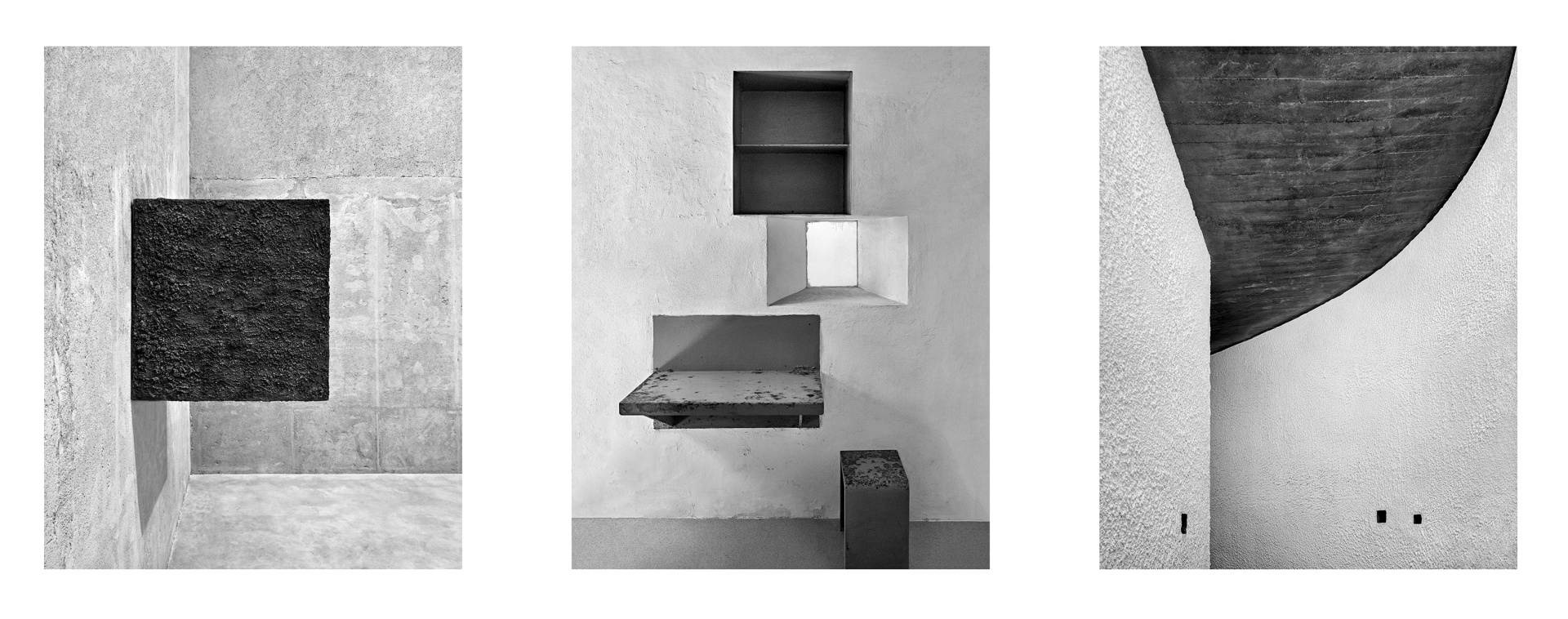
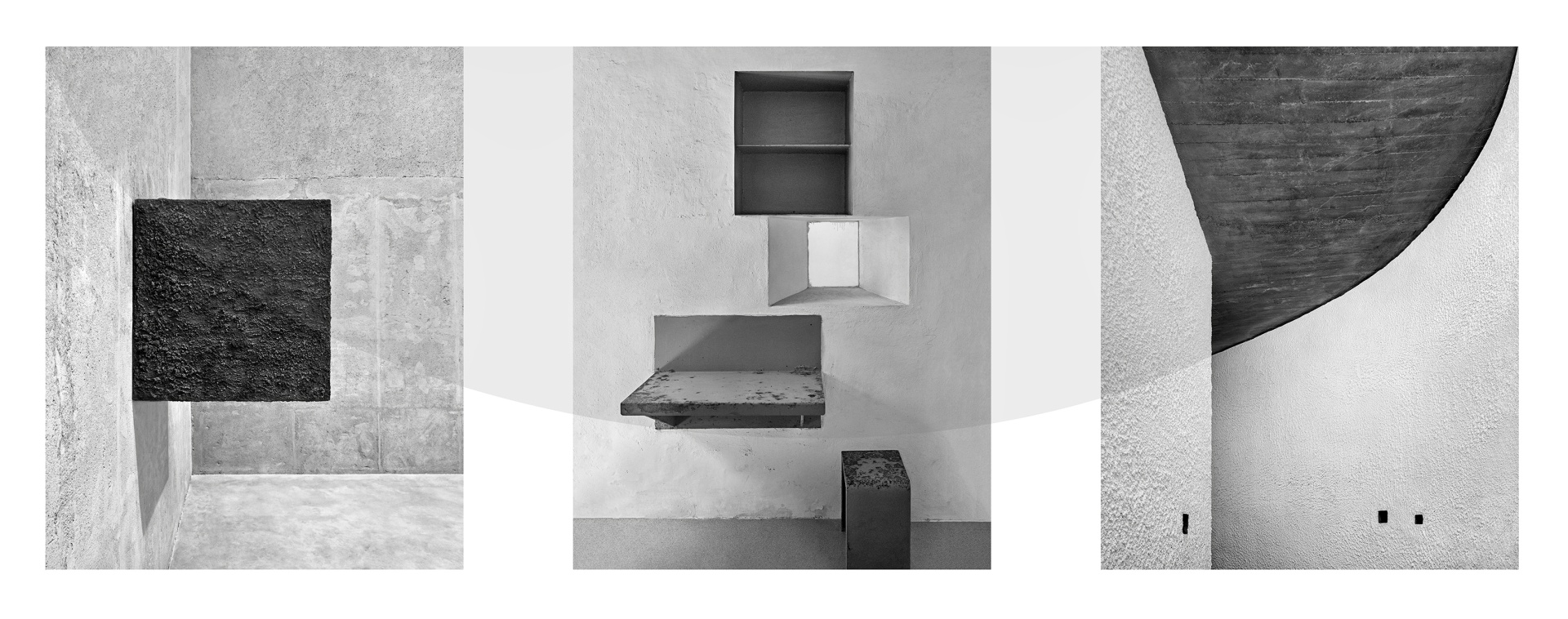
Pino Musi’s photographic triptych is composed of images that reveal, in the background, white walls that can be understood as metonymies of as many different places: the exhibition gallery, the prison cell, the chapel. All three of these places are characterised as extra-ordinary spaces: there is a threshold, a limes, that must be crossed in order to enter them, a separation from the places of everyday life, from the times, norms and values that regulate them. Furthermore, these spaces are such that they impose upon the visitor a set of codified ritual practices that exceed purely functional action and acquire a strongly symbolic dimension, although of different kinds: aesthetic, juridical, religious. These are therefore liminal experiences (aesthetic contemplation, detention, worship) followed by a moment of reintegration, a return to normality. Religious and aesthetic experiences are free and voluntary; those related to detention are coercive and imposed. Yet all three presuppose a recognised principle of authority, further emphasised by the fact that these three spaces are immutable and cannot be altered by those who experience them.
In relation to their intended practices, these places are both physical spaces — spaces that can be touched, measured, traversed and photographed — and meaningful spaces, spaces that transcend themselves: spaces organised through actions, gestures and words in order to express a context. From this perspective, space is not merely a container, but a field of signs and, therefore, a field of possible connections. It is a symbolic activator and, at the same time, a disciplinary principle. Spaces devoted to the manifestation of symbolic values, such as an art gallery, a prison or a place of worship, modulate the gestures and postures of the bodies they receive. These places configure themselves as intentional spaces, that is, as structures that shape the very ways in which they are experienced. This intentional, symbolic and ritual space, shaped by instances of authority, is not a space of representation, but rather the place where acts are founded: a space that prepares possible experiences, determines their meaning and outlines a spectrum of interpretations. As the condition of every possible experience, space is the milieu that prepares and activates the interaction between body and environment. These images, which extract traces of such fields of possibility, do not reproduce environments; rather, they investigate and interpret their potential as spaces that stimulate or restrict — and always discipline — possible forms of connection.
The places are shown empty. What occupies the scene above all is a device that prepares gestures, postures, actions and gazes. The space brought into focus is that of the wall — the archetypal screen — which, by hosting openings, interstices, diaphragms, niches, cabinets and projecting surfaces, modulates and organises the space of action, establishing and directing the “ritual” practices for which the place is intended, while indicating the potential relationships between architectural elements, objects and corporeality. A corporeality that is entirely absent from the scene, yet evoked as the subject towards which the openings and projecting elements of the wall are directed. In particular, attention is drawn to the geometries that shape these ritual spaces, to the formal analogies that emerge, almost as if in search of a minimal essence that, while investigating the topos — the phenomenal place — turns towards an intuition of the elusive chōra: the original and anachronic space, the formal principle, that which makes possible the nature of a place and its immaterial dimension. The chōra is the fertile matrix generating forms, preceding the becoming of the world into “things”; it is the place capable of holding together the concrete and the abstract, the sensible and the intelligible, the space in which place, subject and things participate in one another.
Beyond the wall, with its “intentional” structure directed towards absent subjects, the other protagonist of this triptych is montage: a constructive principle and a compositional apparatus for thinking through images. It is through simultaneous montage that analogies emerge, along with repetitive geometric patterns, interstitial spaces, and the sequence of flat screens in which pure forms are carved out, shaping light and shadow, openings and projections. The simultaneous presence, before the viewer’s gaze, of objects sharing similar geometric forms creates a kind of short circuit between the different places in which they are located, places that are otherwise profoundly distinct.
Marisa Prete